Showing posts with label acoma. Show all posts

Wednesday, August 27, 2014

The Path and The Way - A Creative Process

The Path
30 x 10 Mixed Media on Artist's canvas
$750


The Way
30 x 10 Mixed Media on Artist's canvas
$750

I worked the two painting above not as a set but together. Often when I am painting smaller works I like to do two or more together because I can use the same palette on them. Before my solo show at Gallery Main in Trinidad, Colorado. I had bought a lot of stretcher bars including several to do a triptych. Time and energy curtained that plan. So after the solo exhibit at the gallery I had stretcher bars and canvas left and repurposed them into at least two vertical paintings.

Most paintings sold are horizontal but with houses having more windows and less wall space tall narrow paintings have become quite popular as they fit in spaces between windows and by doors and in halls. They are a composition challenge, however.

Skies painted

I worked these two together from the very beginning so they would be able to be hung side by side should the collector so decide. Even the basic drawings were done to compliment. The path is a visionary view of Acoma Pueblo in New Mexico with the mission church in the background, and The Way is the two "towered" Spider Woman pinnacles at Canyon de Chelle in Arizona. The stairway on the path echos the canyon in The Way.

Putting in the Shadows

I will admit to relatively slow progress working on these two pieces. Maybe because of the flurry in which I worked before my solo show it was nice to relax on these two. But I admit to a lot of staring at the work and waiting for guidance on how to proceed. Not to sound too airy fairy but I believe the muse was with me.

Adding the canyon walls

I wanted the walls of the canyon in The Way to resemble the walls of the pueblo in The Path. Both were walls to my way of seeing it. Visionary or illusionary schools of art are a lot about how the artist sees it.

Nearing completion

Once the major blocks of color were in place it was time to consider the two works separately. And be sure each was a complete composition within itself while carrying over the lessor colors into both paintings.

The Path and the Way Together
Very nearly done

As you can see from the almost done photograph of the two above they will look very good hung together or near each other. But they are two separate pieces of art. This Thursday will be their first public debut in Angel Fire, New Mexico at the Visitor's Center. Visit Binford-Bell Studio in Black Lake or on FaceBook for how you can acquire one or both of these pieces.

Monday, February 17, 2014

High Mesa Dawn

High Mesa Dawn
Mixed Media on artists canvas
28 x 28/40 x 40 on the diagonal
by J. Binford-Bell

I began this composition style with small paintings of New Mexico Missions largely because it allowed the best display of church towers, and a smaller canvas could take up more space on a wall. I sold them often in groups of four which could be arrange in a diamond shape on a wall. In the last year I have begun to enlarge the canvases I use in this manner and expand on the subject matter. I have done two paintings now inspired by Acoma Pueblo and both have been on the diagonal. High Mesa Dawn is by far my largest to date.

First the sky

No sense in spending hours and hours on the heart of the painting and then ruin it by trying to fill in a sky. I think of my skies as an integral part of the painting. They set the mood and to a large degree determine the palette of the balance of the painting. Since I have begun pouring my skies I always think of this part of the process almost magical. Never quite sure what I will come up with.

Then laying in the blocks of color beneath

Then adding in the sunlight
The sky determined where the light of the rising sun was coming from and so all colors have to be laid in with the direction of the light firmly in mind. Watercolor traditionally is lighter colors first and then turning darker. But watercolor canvas has changed that some because the colors can be lifted from it. And it is far more forgiving of layering colors than paper. With the complex buildings of the pueblo I first laid in base colors for the shadows, then added the sunlight on the walls facing the sun. And lastly I laid over some of the warmer yellows and oranges over the early blocks of shadow.

Filling in around the central buildings
I admit to going in a different order on this painting. Usually I do the skies and then the foregrounds. And lastly work on the subject or center of the canvas. As you can see from the progress photo above the foreground was left for last. I think this approach (artists do not always know why they do something) was because wanting to create depth in this painting. I worked from back to front. I also found I changed the sketch in the foreground to give more a sense of height of the mesa.

Foreground floated

I love working rock and canyon walls with a floating technique. This can require more masking to protect the areas you do not want the color to float too. But I will apply water to an area of rock and then drop in various colors of liquid watercolor and in this case a granulation medium which creates a visual texture to the rocks. You can stir with a brush or push the colors this way or that but no painting.

Canvas covered and details beginning to be added

There are chickens on the mesa and sheep down by the canyon floor pens. Ladders are casting shadows, and deeper shadows are added to the passages off the mesa. I am still at this point working largely in watercolor and some inks for detail. Next step is the use of oil sticks to the clouds and sky and to the canyon walls. I did not want to totally cover up the great textures achieved with the floating of mesa walls but I wanted them darker to accent the sun on the pueblo.

Finished painting with ravens and signature
I reposted the the finished painting here at the bottom so you can see how it has changed from the one just above. I did manage to darken my foreground with the oil sticks, and pick up the clouds in the poured sky. I also deepened the shadows, and added more details with pen and ink.

Lastly I add the ravens or crows. There are two flights of ravens in this painting. That was inspired by my visit to Acoma where you can look over the edge and watch the ravens rise from between the mesa walls and soar above you. All my daytime paintings have ravens. They have become a signature of mine. And since the death of a very dear friend there has always been somewhere in the sky one raven that is all alone.

Sky City or Acoma Pueblo is not at this time of drought this rich in water. The adding of water to my paintings of the desert and canyons is a wish or prayer for its return.

I poured the sky on February 4th and finished it twelve days later. Working on High Pueblo Dawn was a spiritual journey in many ways. But that is true of most of the paintings I have done since I quit art fairs and took the one year sabbatical from painting.

Sunday, June 17, 2012

The Creative Process - Birth of a Painting

Sky City Ladders by J. Binford-Bell

I travel with my camera looking for ideas for paintings. Or once, at least, that was the initial purpose for the Nikon.  And then the photos started being an end in themselves. But sometimes there is that good picture or a series of good pictures that isn't quite what you had in mind because of the wrong lens, the wrong light, the wrong angle . . . the gutters.

You get home from vacation and edit your photos and think, in a painting I can do away with those gutters. Time passes and I still haven't done that. Then in a Santa Fe office I saw a painting of Sky City and the ladders to the Kivas, and was remind of the painting I never did. I pulled up all the pictures I had taken that day on top of Acoma Mesa. It was more than just gutters that made them wrong.

First Sketch

On my work table was a sketch book where I had put in a drawing of the Ring of Fire eclipse with just a diagonal horizon below. I had been toying with what was going with that sun/moon combo -- a raven picking out a star from its edge? A canyon scape with river? Monument Valley? A mission church?

Or a Spirit Ladder! Or maybe a combination of several. The mesa with the pueblo being my canyon scape. And sneak in the towers of the Acoma Mission for my hint at the monuments of the Canyonlands.

Central Detail

Thank heaven for erasers. And after I do my basic sketch on drawing paper I convert to sketch to tracing paper because I can make some major changes by moving that over the sketch and transferring elements to different places or adjust perspective. Tracing paper also erases easier. Elements of the ladder and the building and ground upon which it rests were altered numerous times to give them stability and perspective.

At about this time I knew the ladder was going to be the central element and would be outsized as it reached for the eclipse above the pueblo. It represented the native spiritual beliefs. In the background are the towers of the mission representing the religion thrust upon the people.

Getting there

Now to place that detail into the whole. And put the pueblo on top of a mesa. I sketched in the sides of the butte and scribbled in a far horizon of the valley the sky city. Foreground was not quite right not that I could not create the drop with paint.

Possible foreground?

I like the idea but not quite the right size just yet and there needs to be more indication they are moving up a steep trail to the top. However too much foreground detail will take away from the focus of the painting.

Foreground details
I am liking the details of the mesa better and the size and placement of the figures but these scribbled in persons seem too much like sheep herders that I have used in my canyon paintings.

Sculpture at the Sky City Visitor's center

I think they will be carrying pots on their heads. And I like the head scarf as opposed to the shawls. I have transferred the sketch to the canvas but it is still not too late to do these little alterations to my women on the path. This is one of the paintings I will chronicle in photos for a blog or two. Hopefully the painting will be as rewarding as the sketching.

These days it is so easy to skip drawing. There are scanners and enlargers. You can take your photos and with a photo editing program reduce them to just lines to trace and transfer without the gutter. Or you can have it printed on canvas for you and then paint over the top. Creating a whole new scene requires a more creative process.

Tuesday, October 25, 2011

Mission San Esteban Ray at Acoma

Mission San Estaban Ray
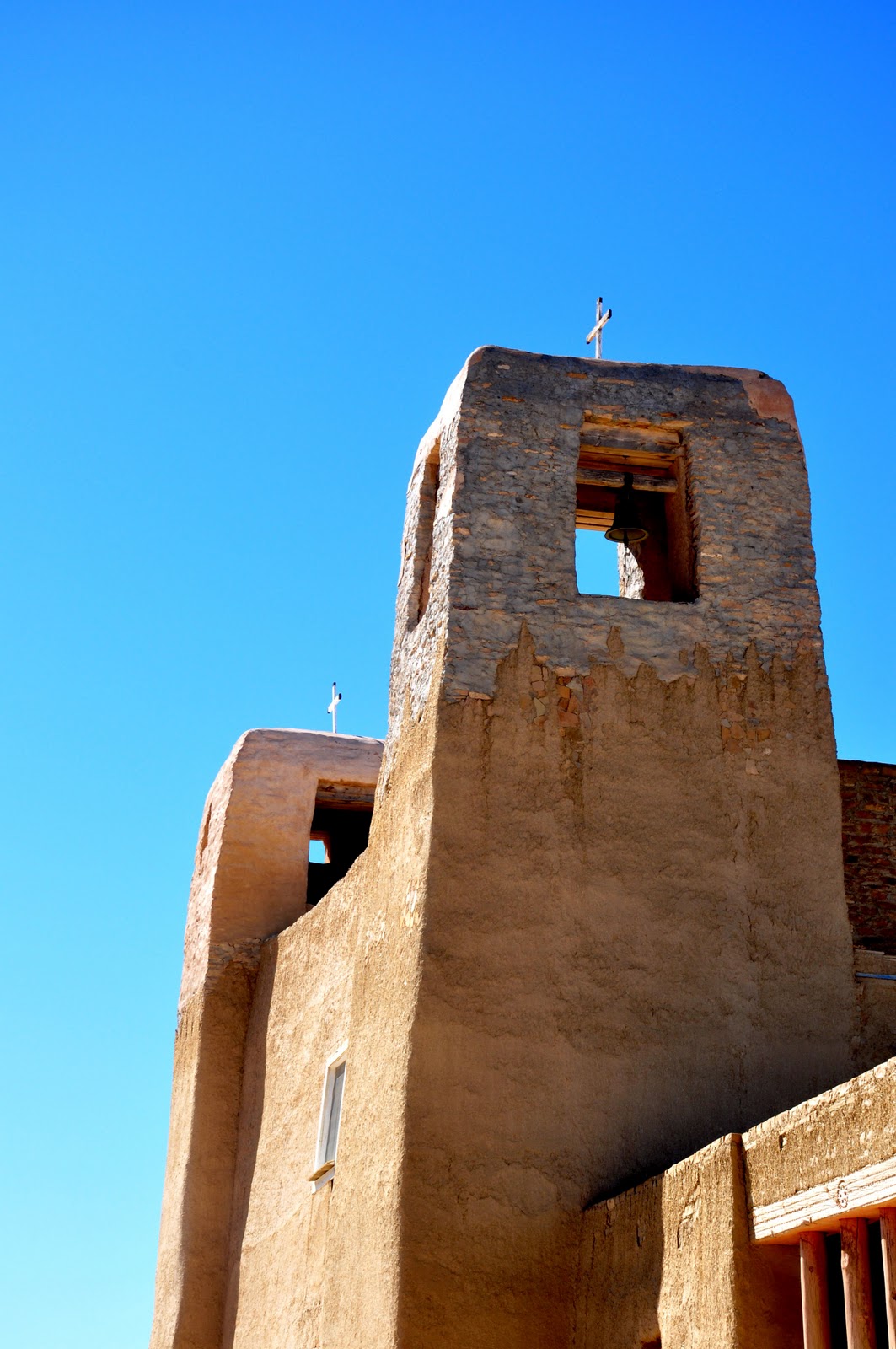
The Mission San Estaban Ray at Acoma Pueblo dates from circa 1641, and has undergone reconstruction. All my pictures are of the exterior because photographs of the alter piece and the santos are not allowed. The mass of the mission and its nearness to the cemetery and other buildings also makes a total view impossible. Still the geometry of the structure makes it a wonderful photographic model.

Two bell towers

Detail of bell tower and original bell
School Balcony
The church and its interior and the art dating from the 1500's are all remarkably cared for even with the treatment the Spanish Catholic church gave the Acoma Natives. Two major Catholic feast days are still celebrated but the center of the spiritual life of the residents are the kivas.

The kivas on Acoma are not round but square as disguise from the Catholic friars and priests. Entrances are on the roof and ladders lead to them.

Kivas and ladders
Many of the residences are also entered from the roof and have ladders to enable access, however the ladders to the kivas are painted white. And the main kiva has a three upright ladder with cross piece to represent clouds. Not sure how this went along with the secret of kivas.

Main Kiva ladder